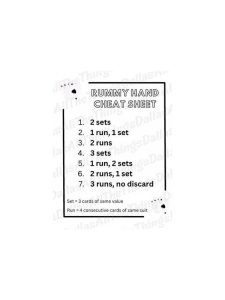
Rummy Comparison: Card Count Versus Plan Quality
A hand can contain many cards that appear connected and still lack a clear route to completion. Card count measures how many relationships you can point to. Plan quality measures whether those relationships can become a valid final arrangement with reasonable decisions. The two measures overlap, but they are not identical.
Count connections first. A card may be linked to a neighboring rank, a matching rank, or more than one possible group. Then test the quality of each link. Does it satisfy suit and sequence rules? Does it require one exact card? Does it compete with another route for the same resource? A large connection count can hide severe overlap.
Check the hand’s balance. A high-quality plan usually has at least one route with realistic completion demand, a manageable number of unmatched cards, and a way to adapt if the next draw misses. It also respects the required declaration structure. A collection of pairs may have numerous connections but no confirmed sequence, while a smaller-looking hand may already contain the essential foundation.
Timing changes the balance. Early in a hand, card count can be useful because it shows where exploration is possible. Near the end, plan quality matters more because theoretical connections have less time to develop. A route should become more concrete as the turn count decreases.
When two choices compete, prefer quality over quantity. One flexible connector that supports two practical routes may be better than three isolated pairs. Likewise, a confirmed legal group can be more valuable than several cards that are each waiting for a specific outcome. Avoid discarding a strong structure just to increase the number of visible possibilities.
Review your hand by marking each card as confirmed, flexible, narrow, or idle. If most cards are narrow, reduce the number of plans. If most are idle, rebuild around the strongest group. If the cards are connected but the declaration requirements are unclear, pause and verify the rules.
The comparison is a reminder that busy is not the same as strong. Count connections to understand options, then judge whether those options combine into a practical route. A smaller, clearer plan often gives you better control than a crowded hand full of attractive but competing ideas.
Do not use card count as a promise about the next draw. It is only a snapshot of the current hand. The snapshot becomes useful when paired with a deadline, a legal check, and a willingness to release cards that no longer serve the strongest route.