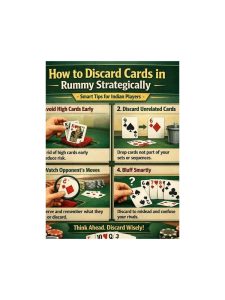
Rummy Tips: Measure a Card by Its Replacement Cost
Players often judge a card by what it can do, but another useful question is what it would cost to replace it. Replacement cost is not a precise prediction of the next draw. It is a practical way to compare two cards that both appear playable.
Begin with the card’s present job. It may belong to a completed group, a developing sequence, or a pair waiting for a set. It may also be serving as a bridge between two possible arrangements. List that job in plain language. “This card supports two neighboring cards” is more useful than “this card feels important.” A card with several jobs usually has a higher replacement cost than an isolated card.
Now count realistic replacements. For a near sequence, ask how many cards could complete or improve it. For a pair, consider the remaining cards of the same rank, while remembering that a set can be less useful than a required sequence in some formats. For a flexible middle card, look at both sides of its rank range. You do not need exact probability calculations; compare the number and quality of routes.
Consider timing. Early in a hand, a card with a high replacement cost may deserve protection because it gives you several ways to organize the rest of the cards. Later, the same card may become expensive to keep if it blocks a clean declaration or carries many points. Replacement cost changes as the hand changes, so reassess after a meaningful draw or discard.
There is also an information cost. If a card can be retrieved from the visible discard pile, replacing it may be easier than replacing a hidden card with no visible clues. Conversely, a visible card may be dangerous to release if it obviously completes a route for another player. Keep these concerns separate: one concerns your own rebuilding task, while the other concerns what your discard communicates.
To use the method quickly, compare two candidates with three prompts: What job does each card have? How many realistic replacements exist? What changes if the hand reaches the next turn without a replacement? Choose the card whose release leaves the cheaper repair. Afterward, review the decision without blaming the random draw. The goal is to improve the comparison, not to expect certainty.
Replacement cost is especially useful when reviewing a close decision. It explains why an ordinary-looking card was retained, or why a promising card was released. If the reason cannot be described in terms of jobs, routes, and repair, the choice may have been based on appearance alone.