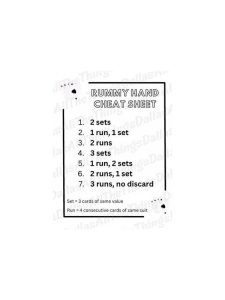
Rummy FAQ: When Should You Break a Nearly Complete Group?

Why break a group that is almost complete? Near completion is not the same as useful completion. A pair may need one exact card while another group can satisfy a required sequence and reduce several unmatched cards. Breaking the pair can improve the whole hand even though it feels like losing progress.
What should I check first? Confirm whether the group is part of a required pure sequence or other format-specific condition. If it is, breaking it carries a larger cost. If it is not, compare its exact completion cards with the routes available elsewhere. Count practical options, not every mathematically possible card.
When is breaking especially reasonable? Consider it when the group has been waiting for several turns, when its completion cards are visibly scarce, or when keeping it forces you to retain a high penalty card. It can also be reasonable when a new draw creates two stronger connections and the old pair becomes the weakest component.
Can I use opponent information? Yes, cautiously. A card repeatedly discarded may appear available, but an unseen copy may still be held. A card taken by an opponent may be riskier to discard or less likely to return. These clues should adjust confidence rather than dictate the move.
How do I avoid breaking groups too often? Give each group a deadline. If it does not improve by a chosen point, reassess it against the entire hand. The deadline is a review trigger, not an automatic discard rule. Break the group when the replacement creates a clearer, more resilient route and leaves a reasonable fallback. Breaking a group should also be timed to the table. Early in a hand, you have room to rebuild and can favor flexibility. Later, a nearly complete group may deserve protection because fewer turns remain. Make the decision with a deadline and a fallback. The point is not to reject progress, but to prevent one attractive pair from controlling the entire hand. A deadline prevents both stubbornness and panic. Set it before the group becomes emotionally important, then honor the review when it arrives. If the group improves, extend its life for a reason. If it does not, release it without treating the earlier choice as a personal failure. Good planning includes changing plans. The review should be short enough to use during play. A few seconds to name the group, deadline, and fallback is sufficient. Longer analysis belongs after the hand, when you can inspect the route without making the table wait.